
Interview with Joe Dumit
Never stop finding your people


Joe Dumit is an anthropologist of passions and performance, brains and games, AI and computers, contact improvisation and slownesses, drugs and facts. He is Chair of Performance Studies, and Professor of Science & Technology Studies, and Anthropology at University of California Davis; and Professor in Interdisciplinary Data Collaborations at Aarhus University (Denmark). His books include Picturing Personhood: Brain Scans and Biomedical Identity and Drugs for Life: How Pharmaceutical Companies Define Our Health. He likes lichen and speculation.
Rima Praspaliauskiene (RP): How do you write?
Joseph Dumit (JD): How do I write? I guess it depends on whether we’re talking about writing an academic paper, single-authored, or joint-authored.
RP: How does it differ for you?
JD: When I’m working on something, I am constantly… it’s hovering, it’s flickering into what I’m thinking about. Often I’ll talk to people about it and research, I’ll read things, something will spark, and then I’ll go down a rabbit hole and read a whole book or two. I’ll be taking notes, everything I’m reading and talking about will be shaping what I’m doing. And then at some point, I need a deadline. It’s like Calvin and Hobbes has this great cartoon, where Calvin’s like, I have to be in the right mood to write. Hobbes says, what mood? And he says, last minute panic. I don’t feel panicked. Even if the deadline is tomorrow. But if the deadline is tomorrow, then I stop going outward and start producing the text that I have to deliver live tomorrow. I can shut out the other distractions.
I have a talk that’s due tomorrow, and I’ve been accelerating the kind of focus I have on what I want to say - what I’m going to say, what slides I’m going to use, how to do it. I still have 24 hours, so I’m still tinkering and making things. And then, for me, weirdly, when I have to actually write a text, it’s still the case that I write kind of very good longhand or on a chalkboard or something like that, because the ideas are swirling, and then when I have to actually write. I can feel the paper coming out as almost a fully written thing. But I can’t pause that. I can either shove it back as soon as I feel it and say, don’t come out now, because I don’t have any place to put you. Once it starts coming out, then I can’t get it back, because then I’m different, and something else will have to come out. So, I try to get myself in situations where I’m in the right place, and be, okay, now I’m gonna, for the next three hours write the paper I feel, beginning to end.
RP: What are these situations? Do you have to be at a certain place where you can write longhand or you talk into the phone?
JD: I haven’t quite worked out the talking thing. I have been recording conversations with people lately, and then using the transcripts to help write. Finding quotes and things like that. But it’s like, if I have to give a 15-minute talk, it’ll come out as a 15-minute talk. It’s that last-minute need for it to be in a particular format that generates the formatted version of it.
Otherwise, ideas keep constellating, creating constellations with other ideas. That process doesn’t have a natural end. I’ve put myself in the position where I have to write something, and that allows me to do it.
RP: And that is the deadline, an agreement to talk, a collaboration?
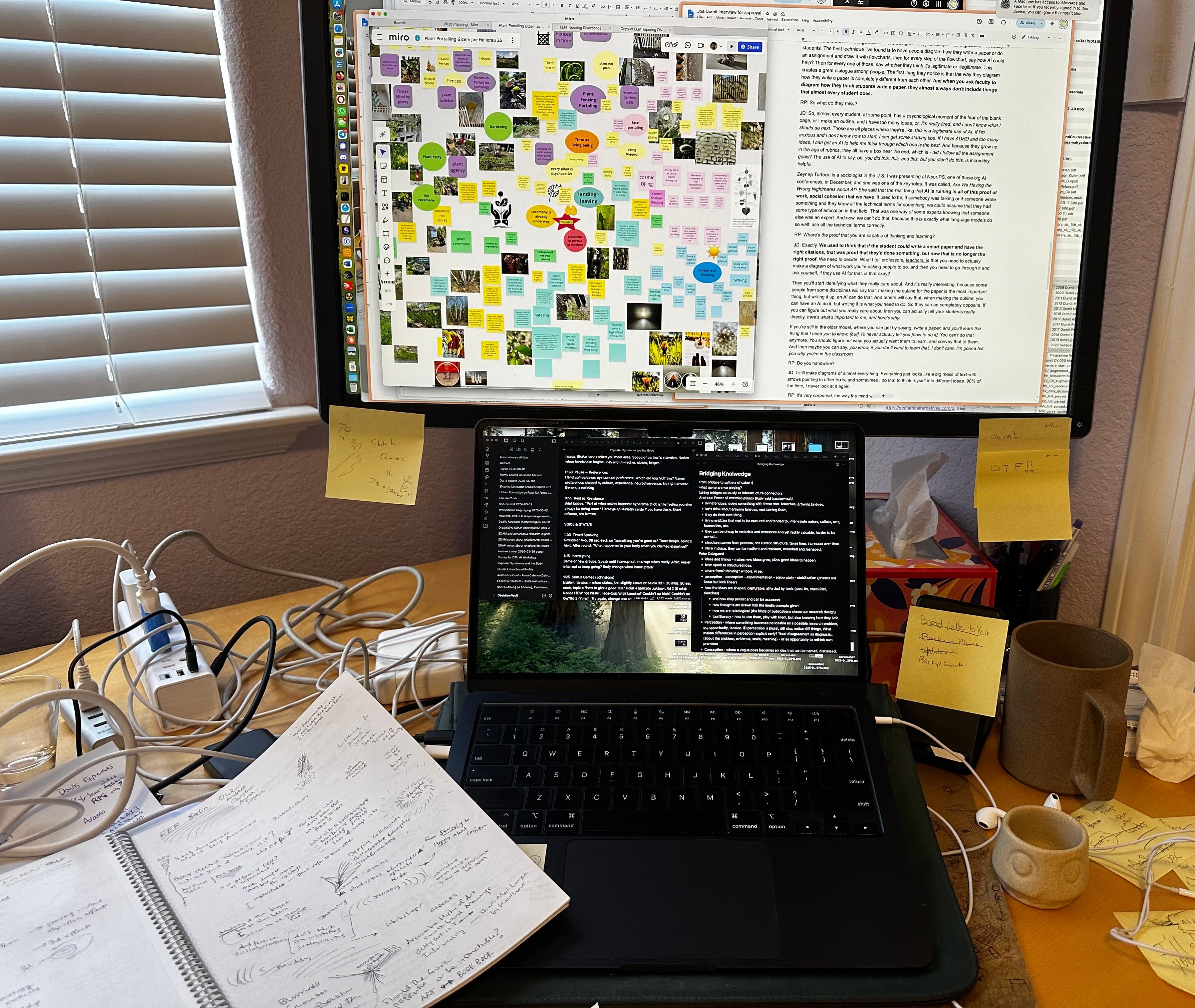
JD: Yep. Co-writing, which I’ve been doing almost exclusively lately, is good, because I can sit down and write with someone. We can talk and write on Google Doc together. I really like Google Docs for that. I keep trying non-Google products, and they are not as smooth keeping all the writing going, although I did just write one with FramePad. That’s really nice, also. FramePad has this beautiful thing, because, you’re editing together, two people typing at the same time, whether we’re on Zoom together, side by side, or separately. And not only can you see the letters as they’re typing them, and see their recent changes, you can also kind of play it back and watch all the changes happen again. It’s like you play the timeline back, and you watch the whole document get edited, which is really cute. But the point of it is, if I’m working with someone, then the last minute is kind of all the time. It’s like, if they write something, then I have a new provocation that I might write back to, so between going back and forth the document might appear.
RP: In a way, collaboration or co-writing is the perfect mode for you to write.
JD: Yes, sure. I hesitate around the word “perfect” though. They’re all fun. It’s quite enjoyable to have a reason to be with people. That’s my main reason for collaborating. And the product is more like a side effect of that. But a necessary side effect. Giving talks and hearing feedback then changes what the next talk can be. It’s always been collaborative. I called my research method for my books and my dissertation constant ethnographic engagement, which is constantly sharing what I’m thinking with people that I’m thinking about. And their questions and feedback and misunderstandings are then how I change what gets written next. My whole approach to words is that they only are their effect. If the word is not landing with the people that I’m saying it to, I’m never like, but this is the right word. I never fight anyone on words. I might fight with them about a particular word, because I think it has a different effect than they say it has. The things I write or talk about are processes. They’re not representations of research. They are the ongoing invention … Words, too, do things.
RP: Do you pay attention to the sound of words and the relationships between words?
JD: I would say absolutely not. I discovered five years ago that I’m completely aphantasic. I cannot picture anything, imagine visually, or remember visually. Sort of auditorily there are words in my head, but they don’t have sound, and they’re not a voice from a subject. The words have never said, you need to do this, or I’m dumb, or whatever people tell me they say to themselves , I have never understood what they’re doing (my words don’t speak to me with I or you). But now I realize some people actually have voices that have accents. They have voices with people, voices that raise their voice. I just have words that are in the moment. And they’re not visual, they’re not auditory, they’re just words. I don’t know what that means, but there’s a whole Facebook group of people like this who have no memory or imagination of any of the senses who say similar things. I can read stuff out loud, but I have never thought about the sound of words on a page. And if someone rewrites what I write. I’ve had this experience of, wow, that does not sound like me at all. But then I’ll read something that I wrote earlier, and I also have the same feeling. I’m, wow, that’s really cool. it’s like encountering somebody else’s writing.
RP: Was that always the same? What was your journey from the dissertation? Has your writing practice changed?
JD: My dissertation was finished in 1995, written from 92. That was way before anything except email. This was back when if you went to a conference and you saw a talk you liked, you would fill out a postcard and send it to the person, and they might send you a paper. All my research was going and taping interviews and then painfully transcribing them on tape, and then printing it all out, cutting up the interview into lots of sections, and then rearranging it on the floor. And as I had thoughts while rearranging, I would write them down on sheets of paper, and then put them in between the quotes. Eventually, I would kind of assemble a pile that could be retyped as a paper, or as a chapter. Even ten years later, I wrote the Drugs book that way, too. Eventually, I reached the point where I needed to produce something, and so that required printing everything- all my notes- out and reassembling them on a huge floor.
RP: A very corporeal way of writing.
JD: Yeah. This may or may not be related, but the one thing I can kind of remember is the kinesthetic or proprioceptive layout of almost every place I’ve ever been - how the door opens, and then you walk in, and you turn left to get to the kitchen, and then you reach down to open up the silverware drawer. I can only walk through the place in my mind. And I can’t see all the colors are just made up and the length of anything, it’s not like a three-dimensional model or something, it’s literally just the feeling in my body as I go through it. But I can do that for, like, twenty Airbnbs that I’ve stayed in Arhus and in Berlin.
When I read someone, the way their argument works and articulates to the world has this kind of feeling. When someone tells me a project they’re working on, the feeling of what they’re telling me resonates with other feelings, and that calls to mind, oh, you should read this book. I couldn’t get to the book any other way, except in that mode.
I have this great app called HoudahSpot on the Mac that allows me to type in almost any words and see them in all the PDFs at once and all my Word docs and whatever. If I can recover any word, then I can find the thing.
Recently I vibe-coded with Claude, a Python program that could run through my 20,000 PDFs, find the 10,000 that I’ve done highlights in, extract all the highlights into very nicely formatted and renamed files. I don’t know what I’m gonna do with this yet, some fantasy of AI helping me think. It is nice being able to get all those highlights out though. It’s always bothered me that I have shelves full of books with lots of underlines that I never went back to.
RP: How do you use AI - just for the highlights, or do you use it for writing? How do you think AI will affect academic writing?
JD: This is a giant question. I’m part of two grants, two Centers, one for AI and Experimental Futures at UC Davis that’s NEH [National Endowment for the Humanities]-funded, and the other is called Text: Contemporary Cultures of Text at Aarhus University. That one’s also located in the humanities. We are constantly asking these questions. I’m constantly talking to people about how they use AI, and running workshops on how to use AI in your research.
I was talking to someone earlier today, and she’s an MD and a historian. She’s been using it to have a sparring partner for thinking through synthetic ideas that are more interdisciplinary than her colleagues. She doesn’t know how to think about it, whether that’s writing with AI or not. You know, if it’s not generating text that you’re cutting and pasting, does that count as writing with AI? If you’re prompting: here’s some ideas, tell me some critical approaches to them, or how would colleagues in this discipline see this argument? What would they see as its weaknesses? And then you get feedback.
RP: Something like if you ask for a word, if it’s better to use this word or that word I already have, is that writing with AI or not?
JD: Exactly. I often use it now to do genealogies of certain concepts and intuitions. Sometimes I can get a pretty good genealogy of how they’re related or not. I have some good prompts that are more about questioning my assumptions than telling me answers.
I don’t know if this counts as writing, but I’ve been trying to analyze 500 threads from Reddit about people with these memory issues, working through 8,000 comments, so I can have step-by-step agents with little prompts characterize the types of personhood in each of the quotes. Then, I can take that archive and collect different domains of experience. Then I can generate a giant HTML file that allows me to see for each topic relevant quotes from the corpus. I can rank the quotes, oh, these are ones I want to use in the future, and these don’t matter. And then I can reprocess the whole thing, export that as a JSON file, and then reprocess the whole thing, so all of my choices have now been moved up. It’s kind of a very quick, fast way of doing qualitative research. And by fast, I just mean less clicking than when i did this with Word docs.
RP: Do you run all these agents on your laptop?
JD: Yeah, because I’m doing research on these models, and how other people are using the models. I’m co-writing with my son on some of the models and how they work, because he’s an AI scientist. I’m using Claude and GPT in some of these, the commercial models.
Andrew [son] tells me that now, if you get a brand new MacBook with maximum memory, you can actually run pretty much the best models out locally, you can mess with them more. That is a future I’ll get into at some point.
RP: It’s the matter of managing.
JD: Yeah, exactly, you become an agent manager. And for different types of coding, it’s super helpful. For writing, it’s really tricky. I’m kind of researching right now how the answers that AIs generate, word by word could generate a thousand different paragraphs and from its perspective, you could say they’re all equal. They’re all coherent continuations of your prompt. You need to realize that assumptions that weren’t in your prompt can slowly be added into the answers. You really can’t trust it. For example, I’m trying to show that with medical questions - if you ask the same medical question of seven different models, you’ll get seven really different answers, and even from the same model seven times, you’ll get different answers.
RP: So still, your agency matters
JD: Your agency’s gonna matter no matter what, because you’re gonna decide whether to take the pill or not. Your prompt matters a lot - how you babysit the model, how you meta-prompt the model. All of these things are super determinant for the kinds of answers you receive, and then your stance to it. Do you see it as actually, in a sense, virtually generating a thousand paragraphs and giving you one of them? Do you realize that, if you think that’s what GPT thinks, you’re just hallucinating? Because it would equally have given you a different answer.
One of the projects I’m here to do is to look at how academics use AI, which includes research and writing and what takes they have on it.
RP: What does your research say? What are your findings?
JD: I mean, it’s all over the place. I have no findings that are statistical. There’s still a great number of people who refuse. There are also people who say they don’t, and then you poke them, it turns out there’s a lot of things that they are doing that they’re not quite talking about, especially students. The best technique I’ve found is to have people diagram how they write a paper or do an assignment and draw it with flowcharts, then for every step of the flowchart, say how AI could help? Then for every one of those, say whether they think it’s legitimate or illegitimate. This creates a great dialogue among people. The first thing they notice is that the way they diagram how they write a paper is completely different from each other. And when you ask faculty to diagram how they think students write a paper, they almost always don’t include things that almost every student does.
RP: So what do they miss?
JD: Almost every student, at some point, has a psychological moment of the fear of the blank page, or I make an outline and I have too many ideas, or, I’m really tired and I don’t know what I should do next. Those are all places where they’re like, this is a legitimate use of AI - if I’m anxious and I don’t know how to start, I can get some starting tips, if I have ADHD and too many ideas, I can get an AI to help me think through which one is the best. And because they grow up in the age of rubrics, they all have a box near the end, which is - did I follow all the assignment goals? The use of AI to say, oh, you did this, this, and this, but you didn’t do this, is incredibly helpful.
Zeynep Turfecki is a sociologist in the U.S. I was presenting at NeurIPS, one of these big AI conferences, in December, and she was one of the keynotes. It was called, Are We Having the Wrong Nightmares About AI? She said that the real thing that AI is ruining is all of this proof of work, social cohesion that we have. It used to be, if somebody was talking or if someone wrote something and they knew all the technical terms for something, we could assume that they had some type of education in that field. That was one way of some experts knowing that someone else was an expert. And now, we can’t do that, because this is exactly what language models do so well - use all the technical terms correctly.
RP: Where’s the proof that you are capable of thinking and learning?
JD: Exactly. We used to think that if the student could write a smart paper and have the right citations, that was proof that they’ve done something, but now that is no longer the right proof. We need to decide. What I tell professors and teachers, is that you need to actually make a diagram of what work you’re asking people to do, and then you need to go through it and ask yourself, if they use AI for that, is that okay?
Then you’ll start identifying what they really care about. And it’s really interesting, because some people from some disciplines will say that making the outline for the paper is the most important thing, but writing it up, an AI can do that. And others will say that, when making the outline, you can have an AI do it, but writing it is what you need to do. So they can be completely opposite. If you can figure out what you really care about, then you can actually tell your students really directly, here’s what’s important to me, and here’s why.
If you’re still in the older model, where you can get by saying, write a paper, and you’ll learn the thing that I need you to know, [but] I’ll never actually tell you [how to do it], you can’t do that anymore. You should figure out what you actually want them to learn, and convey that to them. And then maybe you can say, you know, if you don’t want to learn that, I don’t care. I’m gonna tell you why you’re in the classroom.
RP: Do you handwrite?
JD: I still make diagrams of almost everything. Everything just looks like a big mess of text with arrows pointing to other texts, and sometimes I do that to think myself into different ideas. 90% of the time, I never look at it again.
RP: It’s very corporeal, the way the mind works.
JD: Exactly. I can barely remember anything if I just listen, so I need to doodle, or take notes or make little diagrams. Then I can ask my question off of the diagrams. The fact that I’m kind of transcribing it to that shape changes me. When I think about that topic again, I’ve been changed. I think differently about it, so I see it as much more a processural shift.
RP: Do you ever get blocked?
JD: No, I don’t think so. For me, it would be saying, do you ever get blocked when somebody asks you a question? And you can be like, I’m not really sure what to say, but you still talk. Writing isn’t really a different category than that for me. If the deadline’s not there, then I’m writing, reading, moving around. But when I have the deadline, I tend to be able to produce something that fits the call. It’s also because I’m thinking of these things all the time.
RP: Do you write what you like? Or can academics write what they like?
JD: Yes. Academics should write what they like, write what they care about. I don’t know if it’s because I kind of hacked academia by being in too many disciplines. Whatever I want to collaboratively write, it counts somewhere. It’s always a strange question, because I can say I’ve been really successful; I could also say I’ve been fired for not writing the right thing, so it’s like one nightmare actually happened to me, so that also could be a cautionary tale.
RP: What happened?
JD: One way of narrating is that I did a PhD in History of Consciousness, which doesn’t have a disciplined place to go. I applied for, like, sixty-five jobs the first year and got one interview, which I didn’t get. And then I got the very last postdoc I applied for. I applied for, like, thirty-five jobs for a couple years. Then I did it again and got the last postdoc I applied for. And then I was at MIT at this point in a history of science postdoc, because all my grants had been in history. Most of my publications had been in anthropology. All of my positions had been interdisciplinary.
At least for the first ten years of my [professional] life, anthropology published me and seemed to really like me, but I never got shortlisted or long-listed in anthropology programs, because anthropology of science wasn’t quite a thing yet and probably because I’m just weird enough that at least someone on a committee would not think it was anthropology. When the folks at MIT hired me, they had two positions, so they hired a historian of technology, and me, who was also in a history of technology postdoc. And the historians told me, you are not a historian. They told me to be an anthropologist, because my form of history was too weird (too recent among other things).
Seven years later, the chair of the department, who was a historian of technology, sat me down and said she wasn’t gonna put me forward for tenure. That I wasn’t doing anthropology, despite all my publications being in anthropology. It was confusing. Perhaps they didn’t want me corrupting their graduate students with interdisciplinary ideas. I was told when I first got there by a senior professor that most people only had tenure there because they sued, so I was already applying for other jobs at this point. I didn’t get denied tenure. I literally got maneuvered so that I didn’t go up for tenure, which was probably sueable, but at that point anthropology departments were interested in hiring me. You could view this whole thing as slightly precarious, meaning if I hadn’t applied for that very last thing, I wouldn’t have gotten anything in those years.
Can you write what you like? I don’t know. All I know is I can only write what I can write.
Because I was undisciplined [outside of one academic discipline], I always went to conferences in order to learn how people think differently in different disciplines. When I read a paper or hear a talk, I’m always thinking, how did this person come to think that this is a problem? How are they making their argument? That’s a reflexive practice. I think language models can do that, you could say, but then you are not doing it, and that would be a really sad thing to not learn. The act of trying to understand how someone came to write something that you find weird is an important practice: oh, those kind of people exist in the world, too, and when I talk, they’re listening to me, they’re gonna hear what I say very differently, the way I would have said it before I spent the time to think about how they understand the world. That’s important and interesting, and helps you write differently.
[...]
The shift I have done over the last twenty years is from writing what you think you should write to writing what you want to write, to writing what you want to write with the people you really want to write with. Then the extreme version is - who are the people you really love and you want to spend time with? Anything you do with them is gonna be wonderful, even if it’s not what you think you care about. I don’t predefine what I love, what I really want to write. I actually predefine who I really would love to write with and figuring out where to put it is now a collaborative venture. That’s fun along the way, and maybe you go to conferences together, and maybe you make something together. That makes your whole life a bit happier.
Find your people, and never stop finding your people.
RP: That’s great advice. Thank you for the interview.
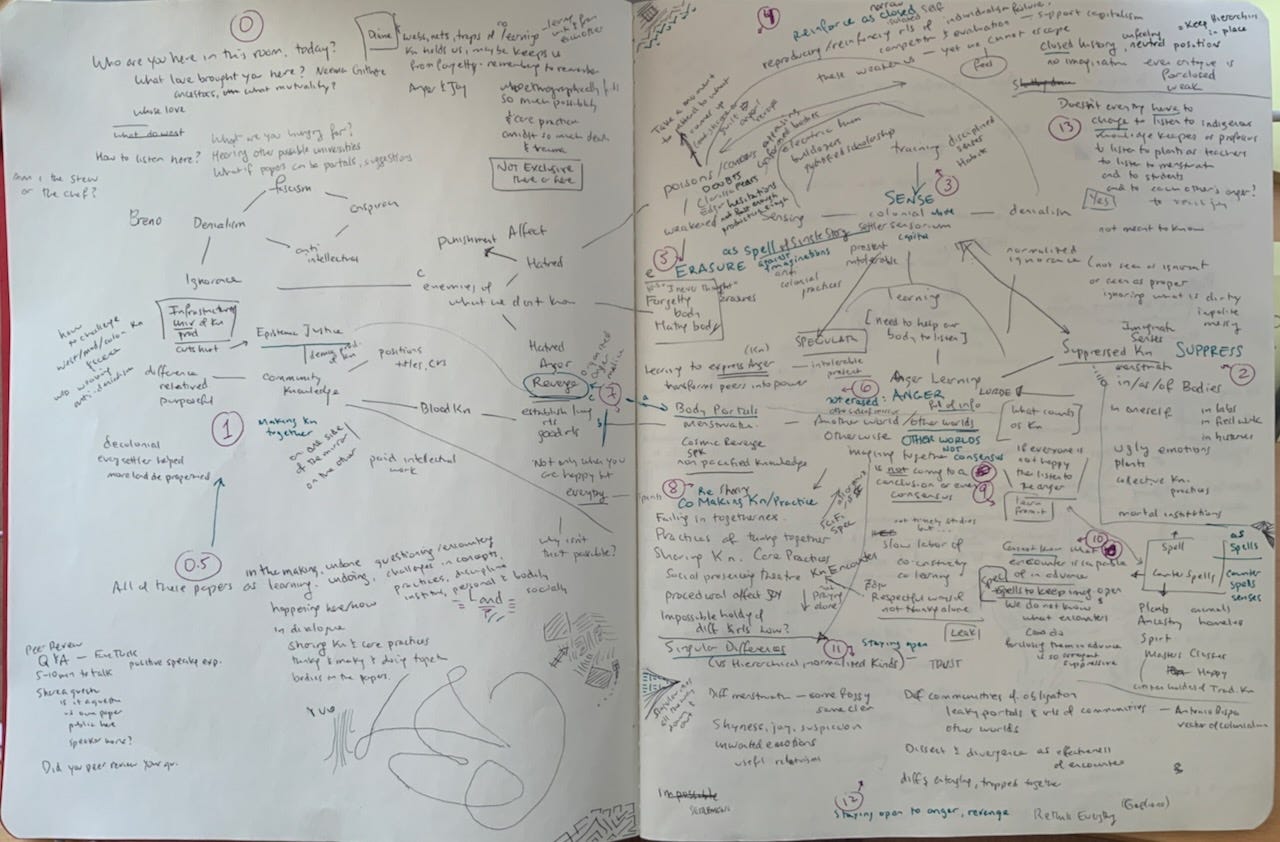
Caption from Joe: I lost my notebook with discussion ideas the day before the panel I had to comment on. I constructed the above new diagram at night and then added more notes, arrows, and numbers as a way through it during the panel. I then channeled this into the following discussion recorded on site and transcribed with the help of otter) (From the 4S/ECOSITE 2002 Society Social Studies of Science meetings, for panel Holding Complex Encounters: Relating in Difference, organized by Isabel De Rose & Emilia Sanabria. Photo: Joe Dumit.